
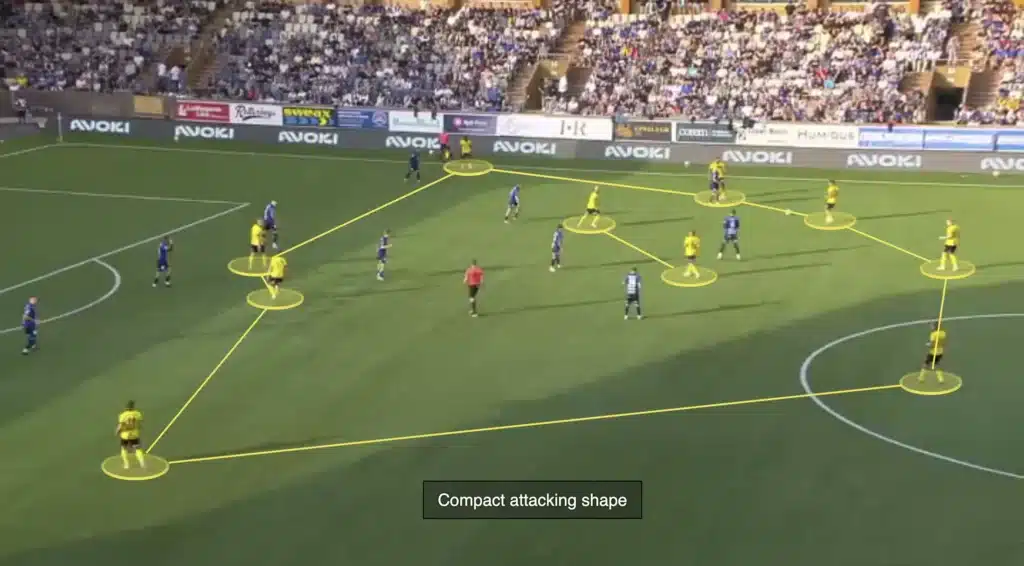
Modern Ligue 1 matches increasingly reflect a structural shift in how attacking phases are constructed. Rather than relying on isolated moments of individual brilliance, many teams now design attacks that operate across several coordinated layers. These layers are not aesthetic choices but functional responses to compact defensive blocks, athletic midfield lines, and the league’s emphasis on transitional speed. Understanding this attacking logic requires looking beyond goals scored and focusing on how space, timing, and player roles interact over multiple phases of possession.
Why multi-layered attacks fit the tactical reality of Ligue 1
Ligue 1 presents a unique mix of physical defending and sudden vertical transitions, which discourages simplistic attacking plans. Teams that commit too many players into a single attacking line often become vulnerable to counterattacks, while teams that remain too conservative struggle to destabilize organized back fours. Multi-layered attacking systems offer a compromise: they allow forward progression without collapsing the team’s overall structure. By staggering players across different vertical and horizontal lines, teams can apply pressure while maintaining defensive security, an equilibrium particularly valuable in a league where turnovers frequently lead to immediate danger.
Structural layering as a response to compact defensive blocks
Most Ligue 1 sides defend in medium or low blocks, compressing central spaces and forcing play wide. Multi-layered attacks respond by creating depth behind the first attacking line and support beneath it. This structure stretches defensive units vertically, not just horizontally, forcing defenders to decide whether to step out or hold position. Over time, these repeated dilemmas generate small positional errors rather than dramatic breakdowns, which aligns with the league’s tendency toward incremental chance creation rather than constant open play.
How midfield staggering controls tempo and access
A defining feature of layered attacks is midfield staggering, where players occupy different heights rather than forming a flat line. One midfielder may position between opposition lines, another slightly deeper to recycle possession, and a third wider to connect with fullbacks. This arrangement regulates tempo by offering safe outlets while preserving forward options. In Ligue 1, where pressing intensity varies sharply between teams, such staggering allows attackers to adapt rhythm mid-match without tactical overhauls, maintaining control even when direct progression is temporarily blocked.
The interaction between wide zones and interior layers
Wide players in multi-layered systems rarely function as traditional touchline wingers. Instead, they oscillate between width and interior channels depending on ball location and opponent shape. This creates interior layers that overload half-spaces while still threatening the flank. The result is not constant crossing, but repeated repositioning that pulls defenders laterally before exploiting central gaps. Teams such as Paris Saint-Germain often use this principle to free advanced midfielders rather than solely targeting strikers, reflecting a broader Ligue 1 trend toward diversified scoring sources.
Decision-making speed and delayed penetration
Multi-layered attacks place a premium on delayed penetration rather than immediate verticality. Players are encouraged to circulate possession until the correct layer becomes accessible, even if that means recycling play multiple times. This patience reduces low-percentage actions and preserves team shape. In Ligue 1, where athletic defenders recover quickly, rushed decisions often neutralize attacking advantages. Layered systems instead aim to shift defenders incrementally, allowing penetration to occur when numerical or positional superiority is already established.
Situational betting interpretation within layered attacking games
When analyzing matches that feature structured, multi-layered attacks, goal timing and momentum often differ from more direct styles. Extended possession phases may suppress early volatility while increasing the likelihood of late breakthroughs as defensive concentration drops. In situations where match flow suggests sustained territorial control without immediate scoring, contextual interpretation becomes critical. During such assessments, observers comparing in-play scenarios across a betting interface may reference ufabet168 ufabet as one example of a football betting website where live odds movement reflects these slower-burning attacking patterns. The key analytical point is not the platform itself, but how layered attacks influence market expectations by shifting goal probability toward later phases rather than early surges.
Where multi-layered attacking systems tend to fail
Despite their strengths, layered attacks are not universally effective. They can stall against disciplined low blocks that refuse to step out, leading to sterile possession. Additionally, if spacing between layers becomes too large, transitions turn dangerous, exposing the team to counterattacks through central corridors. In Ligue 1, sides with limited technical depth sometimes struggle to maintain the precision required, causing the structure to collapse under pressure. These failures underline that layering is not a guarantee of attacking success, but a system dependent on coordination and decision-making quality.
Conditional scenarios that disrupt layered attacks
When opponents commit to aggressive man-oriented pressing, layered systems face different risks. Individual duels replace spatial advantages, and progression depends more on ball security than structure. In such cases, teams must temporarily abandon layering in favor of direct outlets or risk repeated turnovers in deep areas.
Summary
Multi-layered attacking systems in Ligue 1 reflect a tactical response to compact defenses, physical transitions, and variable pressing intensity. By distributing players across staggered lines, teams gain control over tempo, reduce counterattacking exposure, and create chances through accumulated positional pressure rather than constant direct play. However, these systems demand precision and adaptability, and they falter when spacing breaks down or opponents deny vertical access entirely. Viewed holistically, layered attacks are less about spectacle and more about managing risk and opportunity within the league’s specific competitive environment.
