
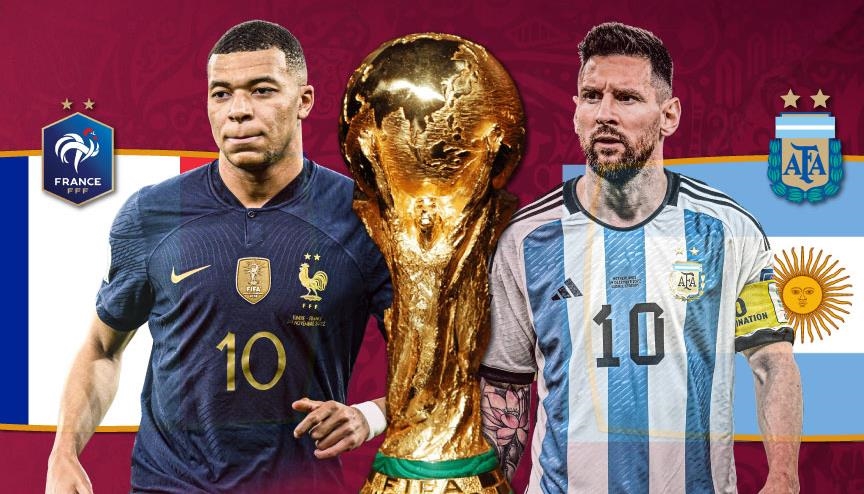
The 2022 World Cup final between Argentina and France combined clear tactical ideas, extreme momentum swings, and elite individual performances in a way that almost never happens in a single match. When you rewatch it as a full 120-minute game rather than as a highlight reel, you see a contest that continually evolves in structure and emotion while still telling a coherent story from kick-off to penalties.
How Argentina’s initial structure took control
From the first whistle, Argentina imposed a clear game plan built around an asymmetric 4-3-3 that morphed into a 4-4-2 without the ball. Rodrigo De Paul dropped closer to Enzo Fernández in the right half-space, giving Argentina a double pivot for circulation, while Alexis Mac Allister stepped higher and left to link with Ángel Di María and Lionel Messi between the lines.
That structure did two things for live viewers to notice. First, it created a stable base against France’s front line, with full-backs Molina and Tagliafico rarely exposed 1v1 in open grass. Second, it opened a clear route to the left-wing overload that led to Di María’s goal: Enzo breaking lines, Mac Allister running beyond, and Di María arriving in space at the far post. For roughly 80 minutes, the shot volume and xG reflected this control, with Argentina leading both chances and territory by a wide margin.
Why France looked so passive for 70 minutes
France’s nominal 4-2-3-1 with Mbappé on the left struggled to engage Argentina’s build-up in a coordinated press. Their first shot did not arrive until the 68th minute, and various xG models recorded essentially zero expected goals for France at half-time, which matched the eye test of a side unable to connect midfield and attack.
For viewers focusing on pressing and block height, the French line often looked caught between pressing and retreating. Giroud and Mbappé did not consistently screen passes into Enzo, while Griezmann was pinned backward, forced into deeper defensive work instead of orchestrating counters. The result was a French team that rarely carried the ball in controlled fashion into Argentina’s half before Deschamps’ dramatic triple change—Thuram, Kolo Muani, and later Coman—altered the dynamic.
The Mbappé surge and how structure broke
The match’s reputation as “the best final” rests heavily on the ten-minute period where Mbappé turned a slow France into a threat almost single-handedly. After Kolo Muani won a penalty and Mbappé scored from the spot, the second goal—a volley after a one-two on the left—came less than two minutes later, compressing France’s entire attacking output into a short but explosive burst.
Shot maps and xG race charts show France’s expected goals climbing from around 0.1 to well over 2 in those closing phases, reflecting not just the penalties but also higher-quality open-play chances as Argentina’s previously compact structure frayed under pressure. From a live-viewing perspective, the key change was mental as much as tactical: Argentina’s midfield line started dropping later, the distances between units grew, and transitions became more chaotic, which is exactly the environment in which Mbappé thrives.
How ดูบอลสด reveals the match’s evolving rhythm
Watching the full game—or ดูบอลสด in real time—matters because the narrative changes if you only see the goals. For 80 minutes, the pacing is that of an Argentina masterclass: controlled possession, well-timed pressing, and France barely entering the final third with intent. The best way to read that phase live is to track Argentina’s spacing in the middle third—Enzo’s angles, De Paul’s covering runs, and the starting positions of Di María and Messi when Argentina recover the ดูบอล changy.
Once the substitutions land and France score, the match shifts into a high-variance rhythm where second balls, broken structure, and fatigue play bigger roles. If you watch it as a full 120 minutes, you experience three distinct games: Argentina’s dominance, France’s comeback, and an extra time where both teams alternately reassert and lose control. That layered rhythm is a big part of why the match feels so rich analytically compared with finals decided by single, isolated moments.
Comparing underlying numbers to what you saw
Statistics from the final back up the sense that Argentina were the more coherent team overall, even if the scoreboard ended level after extra time. One widely cited xG model gave Argentina around 3.35 xG to France’s roughly 2.2, with Argentina generating most of their threat from open play and France’s total boosted by penalties and the late surge.
For viewers, that split helps reconcile the two truths you see on screen: Argentina’s superior structure over most of the match and France’s capacity to create huge, decisive moments quickly. When you note that France’s first genuine shot arrives late and that their xG is almost flat until Mbappé’s explosion, you can frame the comeback as a combination of elite finishing and high-leverage situations rather than as a sign that France controlled the full contest.
xG and chance quality mechanisms in this final
Mechanistically, xG in this match reflects three main chance types: penalties, high-quality central shots from cut-backs and quick combinations, and lower-quality efforts from tighter angles. Argentina’s modelled advantage in open-play xG comes from repeated entries into France’s box via the left and central channels—particularly the Di María goal and later attacks involving Messi and Álvarez—whereas France’s non-penalty xG concentrated in a shorter window of time, largely through Mbappé and Kolo Muani.
Understanding that structure helps a live viewer calibrate their intuition during similar matches. When you see a team create sustained, central shots over long stretches, as Argentina did here, you can treat that as a stronger sign of underlying control than brief, late spikes driven by penalties and one-off combinations, even if both end in goals on the night.
The Messi–Mbappé duel and how it shaped viewer focus
The final’s mythology is also built on the rare sight of both superstars hitting decisive form in the same match. Messi scored twice and assisted the second goal with his involvement in the Di María move, while Mbappé’s hat-trick made him only the second player in history to score three times in a World Cup final, even though he finished on the losing side.
From a tactical viewing angle, their roles drew the eye to different layers of the game. Messi often operated between France’s midfield and defence, slipping into pockets that forced Tchouaméni and Upamecano to constantly decide whether to step or hold, while Mbappé’s wide starting position meant you had to watch the entire left flank—full-back positioning, cover from the near-side centre-back, and Argentina’s rest-defence structure—every time France regained possession. The match effectively trained viewers to track both the “between the lines” space and the far-side threat simultaneously.
A simple sequence for rewatching the final with an analyst’s eye
If you rewatch the full game, using a structured sequence helps you see more than just the drama. Analysts and coaches often break matches into phases and questions; fans can borrow a lighter version of that approach to sharpen their understanding.
- First half: focus on Argentina’s left-side build-up and Di María’s role, noting how often he receives in space, where Mac Allister starts his runs, and how France’s right side (Koundé, Dembélé) copes with those movements.
- Minutes 45–70: watch France’s attempts to adjust, tracking whether their first line presses higher, how often Griezmann gets touches between lines, and at what point Deschamps decides the original plan is not working, signalled by the early substitutions.
- Mbappé’s comeback window: for each French attack, pause mentally at the moment of the regain and check Argentina’s rest-defence shape—number of players goal-side, distances between centre-backs and full-backs, and the space around Mbappé on the left.
- Extra time: focus on fatigue and structure—how far each team’s block sits from their own goal, how quickly midfielders can shift across, and whether either side still commits full-backs forward or starts protecting the flanks more conservatively.
- Penalties: rather than treating the shootout as a lottery, look back at which players took on the highest responsibility in open play—Messi, Mbappé, others—and how their body language at the spot compares with their earlier involvement in the match.
Working through this sequence turns the rewatch into something closer to a film session than a nostalgia trip, helping you understand why the momentum swung and how both sides tried to restabilise once it did.
Summary
The 2022 World Cup final between Argentina and France earns its reputation as one of the greatest matches because it combines long stretches of clear, structured superiority from Argentina with explosive, high-leverage moments from France, all anchored by generational performances from Messi and Mbappé. When you watch the full 120 minutes with an eye on structure, xG patterns, and phase-to-phase adjustments, you see more than a 3-3 thriller: you see a complete tactical drama that teaches you how to read future big games through the interplay of game plans, momentum swings, and elite decision-making under pressure.
