
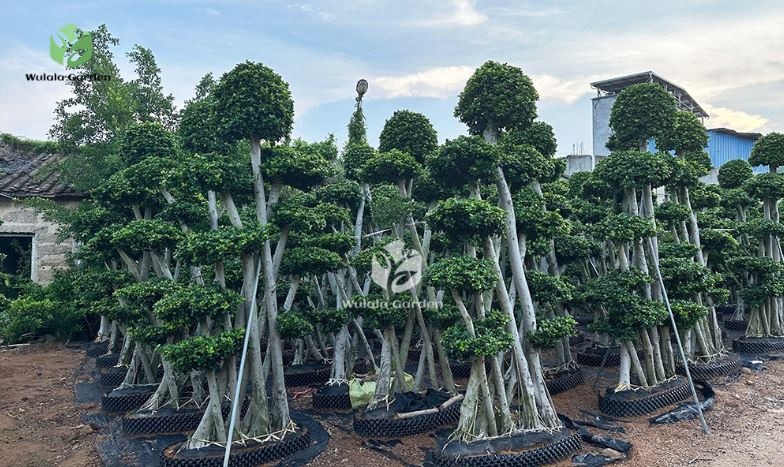
Ficus plants are popular choices for indoor and outdoor growing, but not all varieties have the same appearance or care requirements. One of the most noticeable differences is variegation.
Variegated ficus varieties feature leaves with contrasting patterns of green and lighter shades, while regular green ficus plants generally have more uniform foliage.
Both can make attractive additions to a plant collection, but understanding their differences can help you select the right option for your space.
Appearance
The most obvious difference is the foliage.
Regular ficus plants typically produce leaves dominated by solid green coloration. Variegated varieties, in contrast, can display combinations of green, cream, white, yellow, or lighter green across the leaves.
These patterns can make variegated plants particularly attractive as decorative indoor specimens.
Because each variety can have its own pattern, the exact appearance varies between cultivars.
Light Requirements
Light is important for all ficus plants, but it can be especially significant for variegated varieties.
The lighter portions of a variegated leaf contain less chlorophyll. As a result, adequate light can be important for supporting healthy growth and maintaining attractive foliage patterns.
A bright location with filtered or indirect light is generally a useful starting point indoors.
Regular green ficus plants can also require plenty of light, but their higher proportion of green leaf tissue gives them a different appearance under lower-light conditions.
Growth Rate
Growth rate depends on the specific ficus variety, growing environment, pot size, nutrition, temperature, and light.
Variegated plants may sometimes grow more slowly than comparable fully green plants because their leaves have less chlorophyll available for photosynthesis.
However, you should not assume that every variegated ficus will always grow slowly. Proper environmental conditions can make a significant difference.
Watering Needs
Neither type should be kept constantly wet.
Allowing some drying of the soil between waterings can help avoid excessive moisture around the roots. At the same time, severe and prolonged dryness can stress the plant.
Instead of following a fixed calendar, check the soil and adjust watering according to the plant’s environment.
Factors such as container size, drainage, temperature, humidity, and light can all influence how quickly the soil dries.
Temperature and Humidity
Both regular and variegated ficus plants generally appreciate stable growing conditions.
Avoid placing either type directly next to cold drafts, heating vents, or strong air-conditioning currents. Sudden temperature changes can contribute to stress and leaf drop.
Moderate indoor humidity can also support healthier foliage, especially in homes where heating or air conditioning makes the air particularly dry.
Pruning Differences
Pruning requirements are broadly similar. Both types can be pruned to remove damaged growth, control size, or encourage a more attractive shape.
However, variegated plants may require a little more attention if branches begin producing significantly different foliage.
If a variegated plant develops consistently green shoots, growers may choose to remove those shoots when appropriate to maintain the desired appearance. This should be done carefully because excessive pruning can also stress the plant.
Which Is Better for Beginners?
Both types can be suitable for beginners when their basic requirements are met.
A regular green ficus may be more forgiving visually because its foliage has a uniform appearance. Variegated varieties can require closer attention to light because inadequate lighting may affect growth and foliage coloration.
For someone who wants a decorative statement plant and has a bright indoor location, a variegated variety can be an excellent option.
Which One Is Better Indoors?
Both regular and variegated ficus plants can be grown indoors when provided with appropriate light and stable environmental conditions.
The choice often comes down to personal preference and available space.
Choose a variegated variety if you prefer:
- Patterned foliage
- A brighter decorative appearance
- A statement houseplant
- Cream or white leaf markings
- A more distinctive visual style
A regular green ficus may be preferable if you want:
- Classic green foliage
- A simpler appearance
- A more uniform plant design
- Easy coordination with other green plants
How to Choose a Healthy Variegated Plant
If you decide that variegated foliage is the better choice, inspect the plant before purchasing.
Look for:
- Healthy-looking leaves
- Strong stems
- No obvious pest infestation
- No widespread yellowing
- Well-draining soil
- Balanced growth
- Clear and attractive variegation
You can explore this collection of variegated ficus tree plants when comparing available varieties and selecting one for your growing environment.
Final Comparison
The main difference between the two types is their foliage, but the distinction also affects how growers approach light and plant selection.
| Feature | Variegated Ficus | Regular Green Ficus |
| Foliage | Green with lighter patterns | Mostly solid green |
| Light | Bright light is especially useful | Bright light is generally preferred |
| Appearance | Decorative and distinctive | Classic and uniform |
| Growth | Can be slower depending on variety | Often vigorous under good conditions |
| Care | Moderate | Moderate |
| Indoor use | Excellent with suitable light | Excellent with suitable light |
Conclusion
A variegated ficus can provide a more distinctive appearance than a traditional green ficus, thanks to its patterned foliage. Both types can thrive when provided with suitable light, careful watering, stable temperatures, and well-draining soil.
If your priority is visual impact, variegated varieties are worth considering. If you prefer simplicity and uniform green foliage, a regular ficus may be the better match.
Ultimately, the best choice is the plant that fits your available space, light conditions, care routine, and personal style.
